
What do you know about camera brackets? Faced with different installation requirements, how should we choose brackets that meet the requirements? This article introduces camera brackets and installation methods.
Brackets are supporting products for cameras and housings, and are closely related to the product form of cameras and housings.
1.Camera product forms(partial)

No matter what type of camera, it needs to support multiple installation methods to meet installation requirements in different environments.
2.Bracket product forms
Wall mout

Penndant mount

Horizontal pole mount

Vertical pole mount

Other installation methods

3.Factors to consider when selecting brackets
• Color: The color should match the site environment and be consistent with the camera as much as possible
• Material: Different materials (composite fiber / aluminum alloy / stainless steel) have different strength and
environmental adaptability
• Adjustment angle: Whether it can meet the monitoring angle of the camera
• Weight: Whether the mounting surface can support the weight
• Compatible brackets: Whether additional brackets are required
• Installation environment: Indoor / outdoor installation, protection level, etc.
• Installation method: Wall mount, pendant mount, corner mount, pole mount, whether a junction box is required
Power Box
In some environments, camera power cables need to be hidden or protected. For example, in construction where all wiring must be routed through conduits and cannot be exposed, an electrical box is required at the installation position.
Fuctions of the electrical box: first to conceal wiring; second to portect wiring terminals; third to provide interfaces for wire conduits.

4.Eight installation methods
Ceiling mount

Fixing the camera directly to the ceiling with screws.

Cable routing can be divided into two types: in-wall routing and side routing.
Pendant mount

A method of adjusting the camera to a certain height using a hanging device.
Wall mount

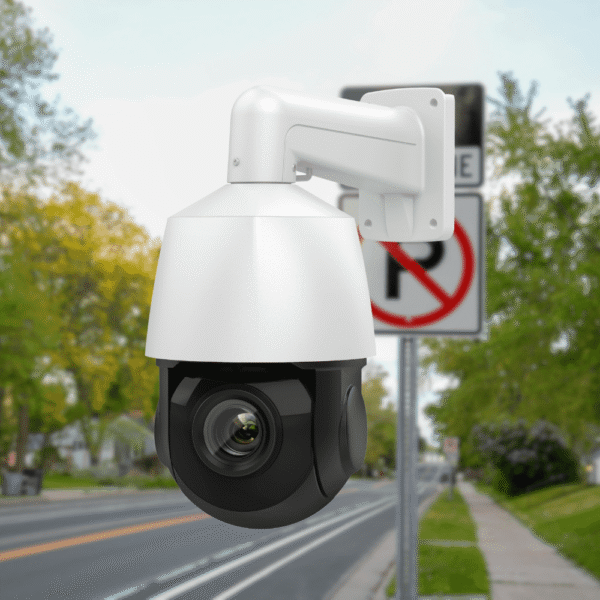
A method of fixing the camera on a wall using a bracket, also understood as “arm mounting”.
Pole mount

A method of fixing the camera on a roadside pole. The current method is to create a flat mounting surface using clamps and sheet metal.
Embedded mount

Generally suitable only for indoor ceiling installations, typically used for dome cameras and PTZ cameras with transparent covers.
Corner mount

Over-the-top mount

When equipment cannot be directly fixed on the outer wall of high-rise buildings, a bracket is fixed on the inner wall and then extended outward with an adjustable arm to achieve the required angle.
Junction box mounting

For dome cameras where cables cannot pass directly through the ceiling and external wiring affects appearance, a junction box is used to conceal cables and connectors for better aesthetics.
Inclined base mounting

When dome cameras are ceiling-mounted or wall-mounted in deep corridors, blind spots may occur due to angle limitations. An inclined base is used to compensate for the angle (corridor mode).